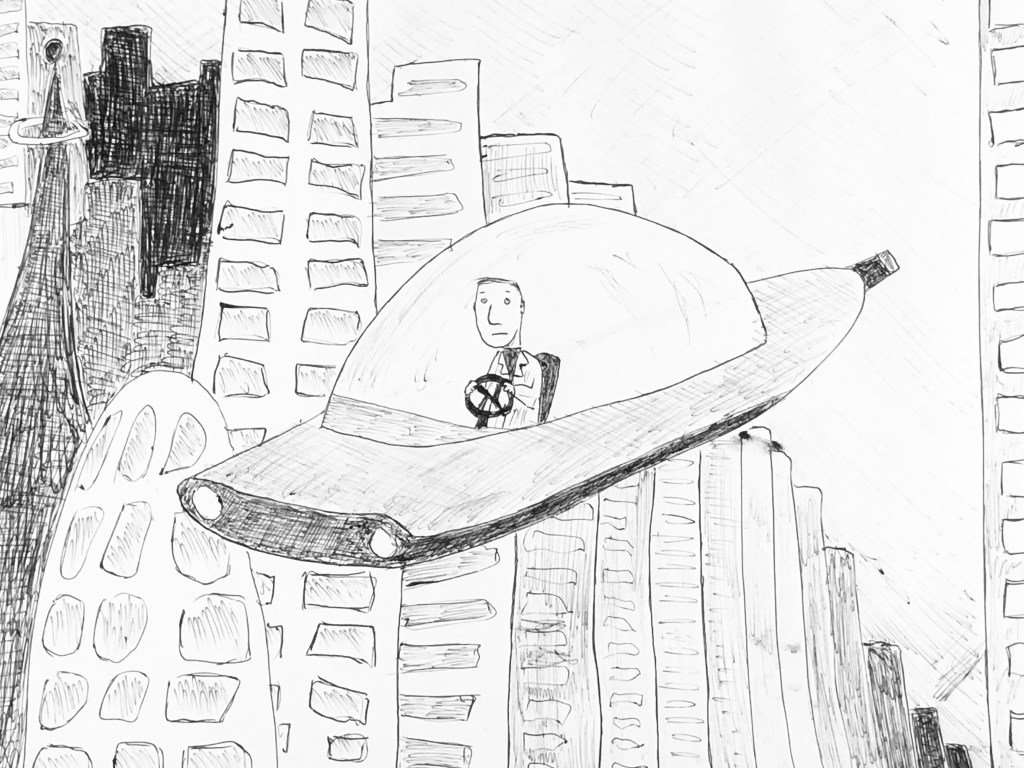
Paolo Chianta is a British writer and animator whose first short film, Punderton, caught my eye in 2021. Its minimalism concealed a mystery. It seemed simple but left you with a lingering feeling. A couple more films followed, all sharing the same DIY aesthetic and layered, intriguing stories narrated by the filmmaker himself.
Paolo Chianta takes care of every aspect of his films, working with complete freedom and whatever means are available to him. I think it’s part of my fascination for his work: these are the kind of films that make you want to create your own.
Paolo kindly agreed to share with Underdog how his ideas are developed and how his projects take shape.
Your short films seem to be 100% homemade: you produce, write, direct, animate, narrate and compose the music. Is it what attracted you to animation: the possibility of being a one-man band?
I originally wanted to be an animator when I was a kid but gravitated more towards writing. And a few years ago I was thinking about making a live-action short film but then the pandemic happened. So I was stuck at home and there were ballpoint pens lying around and paper and it all happened from there. Definitely the notion of being a one-man band attracted me, particularly being able to craft the tone with the sound and music in a way that’s beyond your reach as a writer. It’s a way of bringing to life those weirder ideas that you can’t necessarily communicate through a script alone.
How do you work on a short film? What tools do you use? How long does it take from initial idea to completion? Is it usually a side project or something you focus on for a while?
It’s a pretty lo-fi process. I draw with black ballpoint pen on paper and trace over using a lightbox. Then I photograph the drawings using my phone and upload them to the Premiere Pro editing software and stitch them together in little loops for each clip. They’re taking longer to make. Punderton took a few weeks. Tap Runner was a few months, and The Role I worked on sporadically for a year before working fairly solidly for a couple of months to finish it. They’re usually side projects, though The Role took a bit more focus towards the end as it was longer and more complicated. It became a bit of a full-time job for a while too when I got some funding to produce a load of ballpoint animation for my friend Colin Hickey’s hybrid live-action/animated feature film Perennial Light, which was funded by the Arts Council of Ireland.
I also produce the music for the films myself using GarageBand on my phone, playing the tiny keyboard on the screen. People always ask why I don’t just play an actual keyboard but there’s something about the difficulty of playing this comically tiny keyboard that forces me to play a certain way.
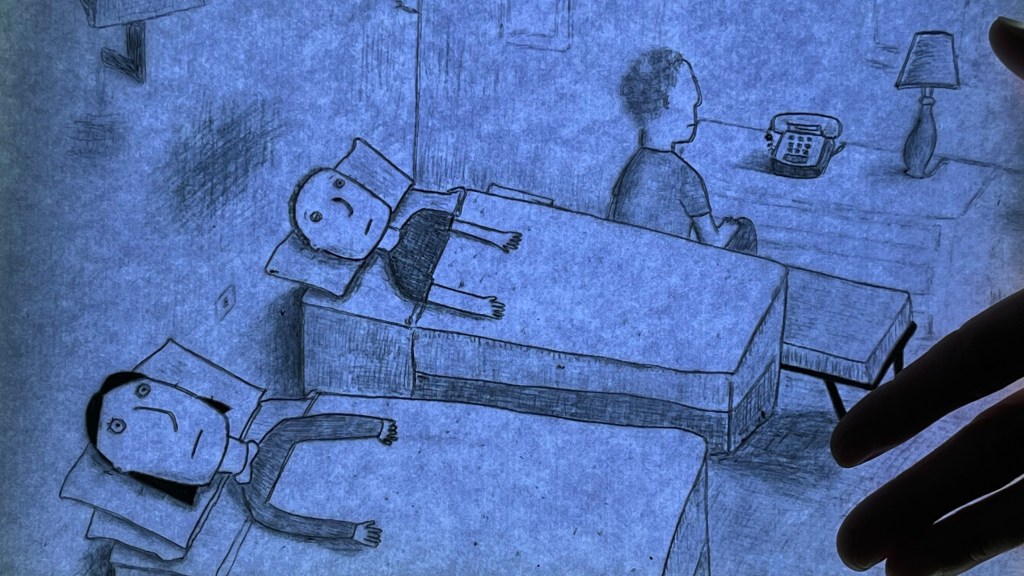
Your films are made of a few simple ingredients, yet they’re incredibly personal and impactful. It’s a lesson in “less is more”! How did you find your voice and style?
I’ve always drawn in that style and initially it was just a case of getting something down on paper to work with. I work well with restrictions and it was always about embracing the limitations and doubling down on them. So I only use pen and paper with no digital touch-ups afterwards. A lot of the time it’s just three still drawings that give the illusion of movement due to slight differences. I found I really liked that look. For the first film, I recorded the voiceover myself as a temp track as I wanted my friend to do it. But when everyone heard it, they told me to keep my own voice on there – something about the depressing monotone of my voice fit the general tone I think! So I grudgingly stuck with my own voice for the next films as one of the key ingredients.
With each film I’ve tried to push myself and be a little more ambitious. So Punderton was quite primitive. But with Tap Runner it was set in this more immersive sci-fi world and the drawings became a little more detailed, with more movement. And after doing more realistic life drawing-style animation in 16:9 aspect ratio for Perennial Light, which was needed for the project, I went for a slightly more detailed style for The Role also in 16:9. But for The Role,the biggest development was the addition of characters speaking actual dialogue.
There is a dream logic to your films, from the (distorted?) childhood memory in Punderton to the peculiar encounter in The Role. Where do these ideas come from?
I made Punderton without really thinking about what it meant to me or any specific inspiration, and sort of gradually realised where the films were coming from and had influences in mind. Tap Runner and The Role were both abstract interpretations of live-action feature film ideas of mine. There is a lot of personal stuff in them that I often don’t realise until afterwards. The Role originally came from something I read about an actor who’d been hired to play someone famous in a biopic, and the famous person’s kids either highly approved or had an objection to this particular actor playing their dad, I can’t remember which. Either way, I thought there was something odd and fascinating about that.
The eeriness of the situations is also conveyed by the music. Your work is sometimes evocative of Lynch & Badalamenti. What are your inspirations and influences?
I always want the films to feel like forgotten or half-remembered films from the 70s or 80s. I grew up watching a lot of repeats of creepy old British cartoons from the 70s and 80s, which were sometimes on in the evening so I wasn’t sure if I was meant to be seeing them. A lot of weird stuff like Murun Buchstansangur and Stoppit and Tidyup. And I always loved those old cartoon shorts they’d have on Sesame Street. There was just a certain atmosphere and these animations were usually narrated too. I think I started subconsciously trying to recreate the memory of these animations to express certain feelings of existential dread.
It’s probably obvious that I’m a huge fan of Lynch and Badalamenti! For each film now I tend to have different references, filmmakers, pieces of music or places in mind. For Tap Runner I was thinking a lot about Kubrick, early David Cronenberg and the Barbican Estate in London. For The Role it was Jarmusch, Robby Müller, L.A. and the music from Vertigo. Even if the music probably all ends up coming out like Badalamenti!
You write for different media: TV pilots, radio dramas, short films… What are the main challenges for each format?
I love writing them all. I suppose with live-action TV scripts, budget is a concern in a way that it isn’t with radio or animation. The only challenge with radio drama is the lack of image: certain information has to be conveyed in a certain way. My process with the short films is less collaborative, at least at the moment, and this can be a challenge when it comes to the technical side of things and making the call on the final draft. With The Role I did work with my friend Lilah Vandenburgh, who acted in it. Previously I’d made these films in private and then shown them to people, but I showed Lilah the script for The Role in advance before we recorded the voices. I remember adding a few lines to improve it and writing with her voice in mind, changes I’d never have made if I wasn’t sending it to her. And that added a whole other dimension to it.
Cover image: Tap Runner by Paolo Chianta
Many thanks to Paolo for answering our questions!
 UNDERDOG