The world’s biggest short film festival, taking place in the centre of France, ended yesterday after 9 days of screenings, meetings and happy hours. Its key ingredients remain the same year after year: a wide selection of films going from remarkable to forgettable; long minutes spent looking at the calendar to try and squeeze in as many screenings as possible; committed spectators dissecting their opinions in queues while I’m eavesdropping to guess which film they’re talking about; tired teachers telling their students off for looking at their phone in the cinema (at least they know how to adjust their screen brightness, unlike their elders).
With such a vast official selection, it is impossible to be exhaustive, but after watching over 80 of the 139 films in competition, I have gathered enough favourites from the 3 categories (international, national and lab) to put together a very subjective list of highlights.
A general comment first: a handful of films, despite their obvious qualities, gave the annoying impression that they were the first 20 minutes of a feature film (something one of the filmmakers confirmed in a Q&A). I know the film industry sometimes considers short films as a “calling card”, but when a short is actually a proof of concept for a feature, it shows, and I feel a bit duped. It’s frustrating to see a film that doesn’t do justice to its format. I love seeing a short that knows exactly how long it needs to tell its story, and these are the films I’ll focus on here.
The Singers, by Sam Davis
Here’s a great example of a perfectly self-contained film (not a surprise given it’s adapted from a short story by Turgenev). A dozen weary-looking men gather in a pub after work, and the usual chatter turns into an impromptu song contest. The Singers has nothing to demonstrate, no point to make, it’s all about the experience. You can smell the cigarette and feel the sticky floor beneath your feet. Fascination grows as these men reveal one by one unexpected talents. I’d watch this 100 times over one minute of The Voice.
Im Auto Tapes Und Butterbrot (With Tapes and Toasts in the Car), by Kiana Naghshineh
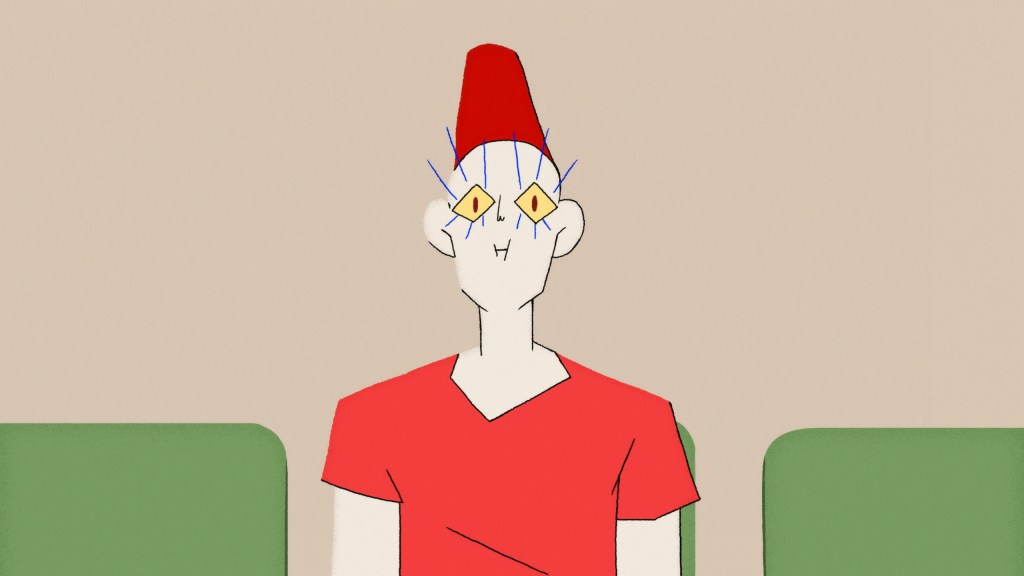
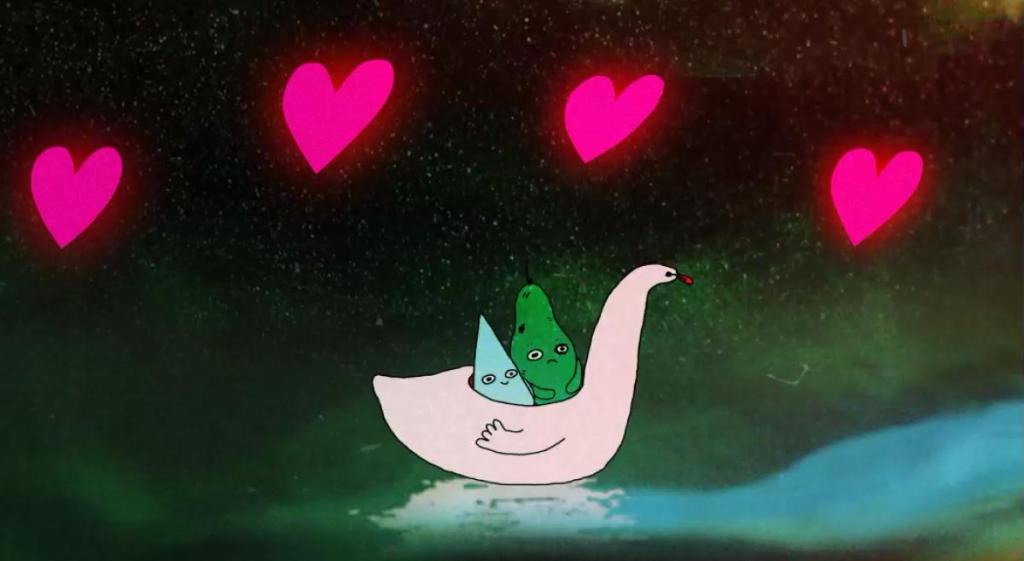
From a tragic premise – a young woman learns she has an incurable disease – Kiana Naghshineh crafts a beautiful film, full of colours, powerful metaphors and intricate emotions. The subject is as deep as it gets yet the treatment is luminous. Animation does its magic tricks, allowing fluid transitions and rapid shifts in scales. Tears are shed but there’s no pathos. For a film that makes you face your own mortality, it is strangely comforting.
Air Horse One, by Lasse Linder
My favourite documentary of the festival is about a horse who travels in business class. Did you know about equine air travel? Lasse Linder gives us privileged access to this surreal parallel world where fortunes are spent flying sport horses to competitions. With long static shots and no voice over, the director relies on the editing (and a cute little dog) to convey the sad irony of the situation. It reminded me of the work of another Swiss filmmaker, Corina Schwingruber Ilić, who happened to serve on this year’s jury.
A Real Swedish Midsommar, by Ville Gobi
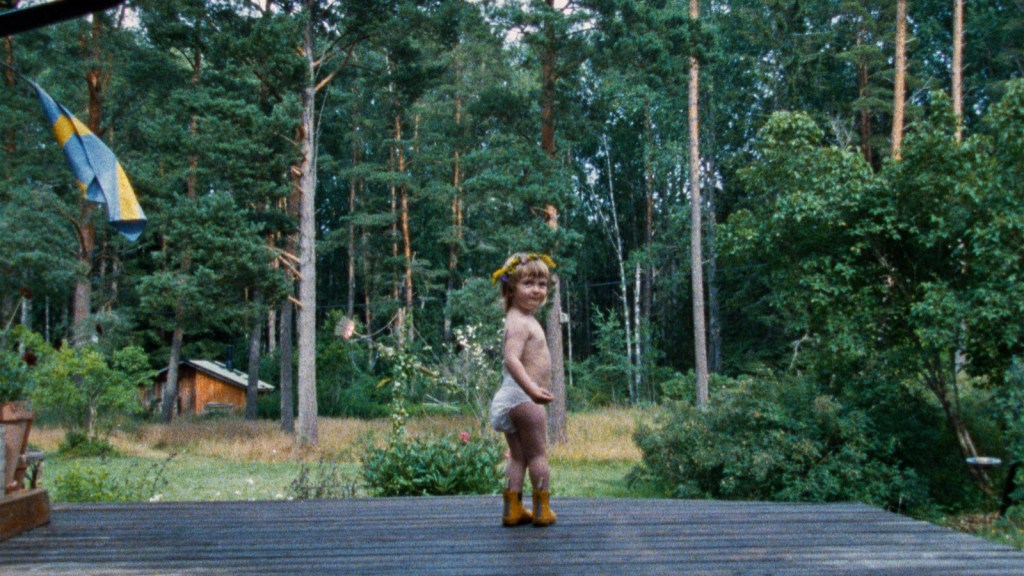
Swedish filmmakers often excel at deadpan humour and slick visuals. In another vein, Ville Gobi offers us a loud, messy and sweaty comedy that perfectly captures the atmosphere of a boozy family meal, with overlapping conversations and adorable kids stealing the show. The lively editing, the fun twists and the special appearance of a famous rock song all make for an irresistible party that you don’t want to miss.
Du pain et des jeux, by Judith Longuet-Marx and Léa Tarral
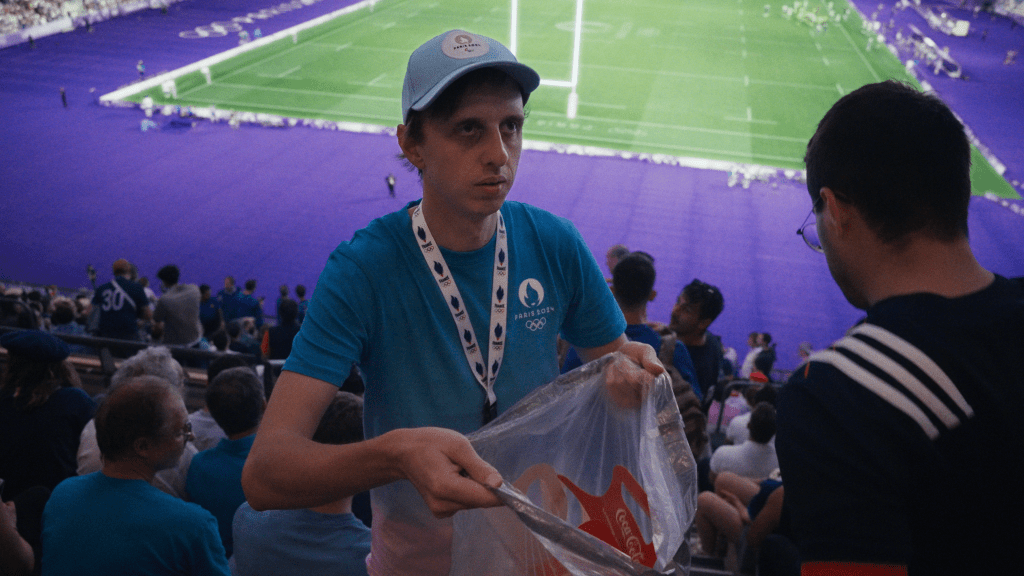
A French film that makes me laugh is a precious thing that I always cherish. In this bittersweet comedy where nothing much happens, Ferdinand volunteers for the Paris Olympic Games and writes songs with his best friend. What takes place “for real” is only one aspect of the film though, the other being Ferdinand’s monologues, delivered with great talent and precision by the main actor/character – a master in “let’s play pretend”. The contrast between the disappointing outside world and the beauty of Ferdinand’s imagination ends up being surprisingly touching.
Mother of a Son, by Kevin Koch
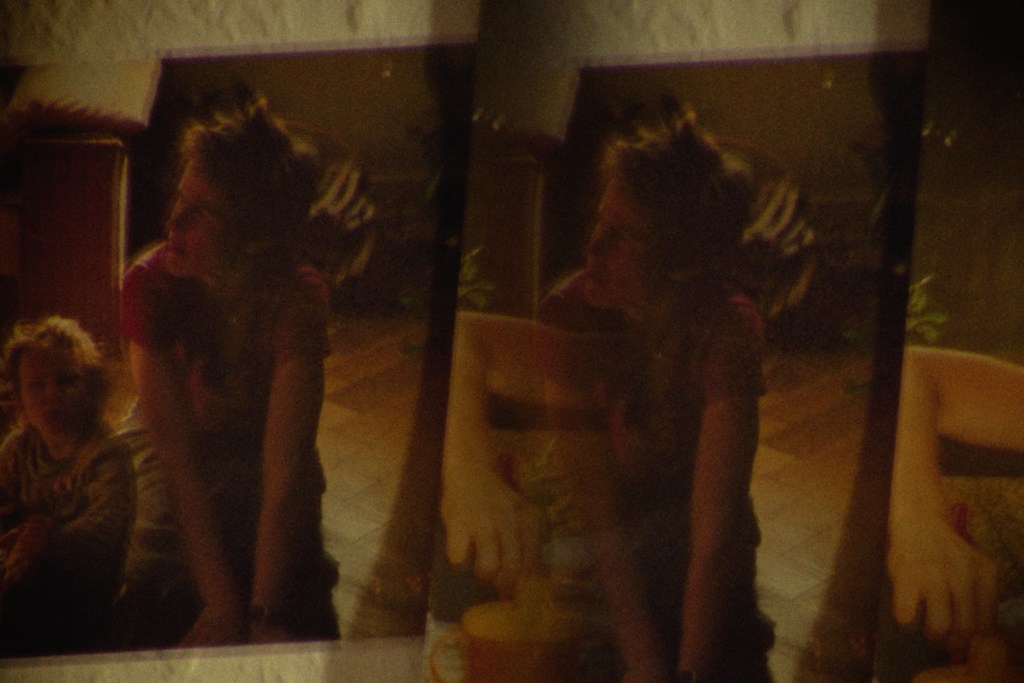
I approached this film with caution, having read its synopsis that reminded me of We Need to Talk about Kevin. I was relieved to discover a delicate drama that focuses on the aftermath of a tragedy without ever indulging in sensationalism. The story centres on the actions of a woman (the mother of the title), whose day-to-day activities are haunted by the memories of her son. The muted colours and the slow pace of the film give it a meditative quality, and the careful composition of the shots invites us to observe the character from a respectful distance.
Easter Day, by Mikola Zasieiev
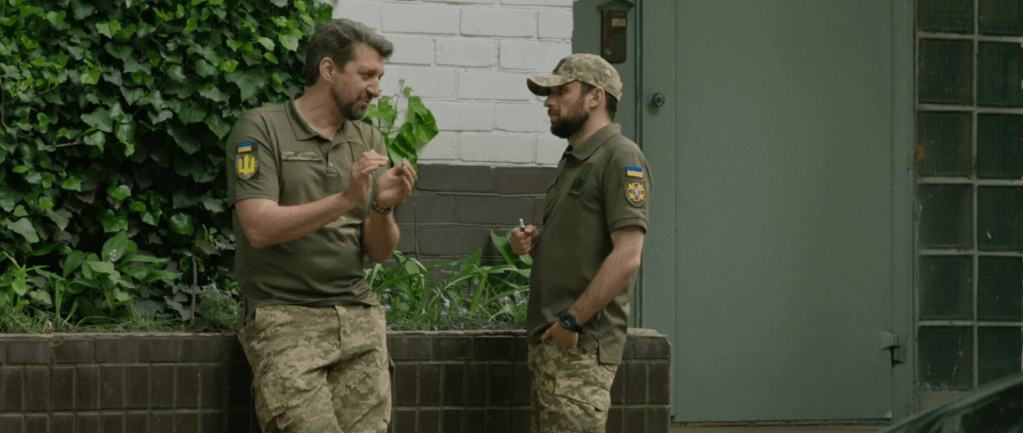
Short films are a great way to take the pulse of a society and this year’s selection featured several films that dealt with war in unexpected ways. In Easter Day, a comedy drama set in Kyiv, we follow two soldiers roaming the city in search of potential recruits, until they come across a young man who seems like the perfect candidate. Instilling humour in such a heartbreaking tale is no mean feat, and Mikola Zasieiev does it with great generosity and respect for her characters.
Dar Band (Citizen-Inmate), by Hesam Eslami
This Iranian documentary turns the camera on the repressive forces to portray a dystopian society where every citizen is under surveillance. In a “centre for electronic monitoring”, officers track the movements of hundreds of people on their computer screens. The film conveys the horror and the absurdity of the situation with impactful images, such as this old man struggling to adjust his trousers to cover his ankle monitor. Keeping the physical violence off screen to document the banality of evil makes the film all the more chilling.
Their Eyes, by Nicolas Gourault
Despite being a long-time fan of Nicolas Gourault’s work, I still hadn’t seen his latest film that has been touring festivals for a year. I’m glad I got to experience it in the cinema. The filmmaker pursues his investigation into AI and self-driving cars, focusing on the human workers who painstakingly label video footage to train algorithms – identifying people, animals, plants, road signs… A captivating reflection on how tech companies in the Global North rely on underpaid labour in the Global South and shape how artificial intelligence perceives the world.
And now some special categories:
- Heartfelt documentaries using personal archive
In I Want My People to Be Remembered, Hélène Giannecchini interviews the American photographer Donna Gottschalk, who documented the life of her queer community in the 60s and 70s. There is something profoundly healing about this film that introduces us to a talented artist and shines a light on forgotten lives.
Murewa, directed by Ché Scott-Heron Newton, recounts the friendship of Marlon and Murry over the years – what brought them together and what made them drift apart. It is both an implacable illustration of the different hands we’re dealt in life and a moving declaration of love. The fact that I like skateboarding videos probably plays a part in my appreciation of this film.
- Subtle French dramas about men dealing with their family’s heritage
Nadhir Bouslama’s Sous les ruines follows Hedi, who returns to Tunisia for his cousin’s wedding and faces unresolved personal issues. In Lucas Gloppe’s Mardochi, Vincent makes an unexpected encounter on his trip back from Rabat, where his ailing father grew up.
The two films share a few common points: secretive characters questioning their roots and the sense of “home”, layered performances (by Majd Mastoura and Arthur Igual) who admirably convey the complexity of the characters, and emotions that infuse slowly before leaving you devastated without warning.
- Brilliant animated films that deserve their own article
I can’t finish this article without mentioning Jocelyn Charles’s metaphysical ride Dieu est timide (God is Shy) and Pierre-Luc Granjon’s pinscreen masterpiece Les Bottes de la nuit (The Night Boots), two French animated films that have deservedly gathered many awards in the last months, and have secured a permanent place in my personal hall of fame.
 UNDERDOG