A few weeks ago I sent an email to a friend asking for a life update, and got a lovely reply. Her main news was the work she had been doing on her allotment. She described the benefits of spending time outside, the satisfaction of seeing the garden take shape and the pleasure of bringing flowers home. This made me really happy – not just hearing about her new activity, but knowing what, in her daily life, brought her joy.
With everything that’s happening in the world, it’s been hard to find anything to rejoice about lately, and as the first month of the year is drawing to a close, I thought I would share a short documentary that feels like a balm for the soul.
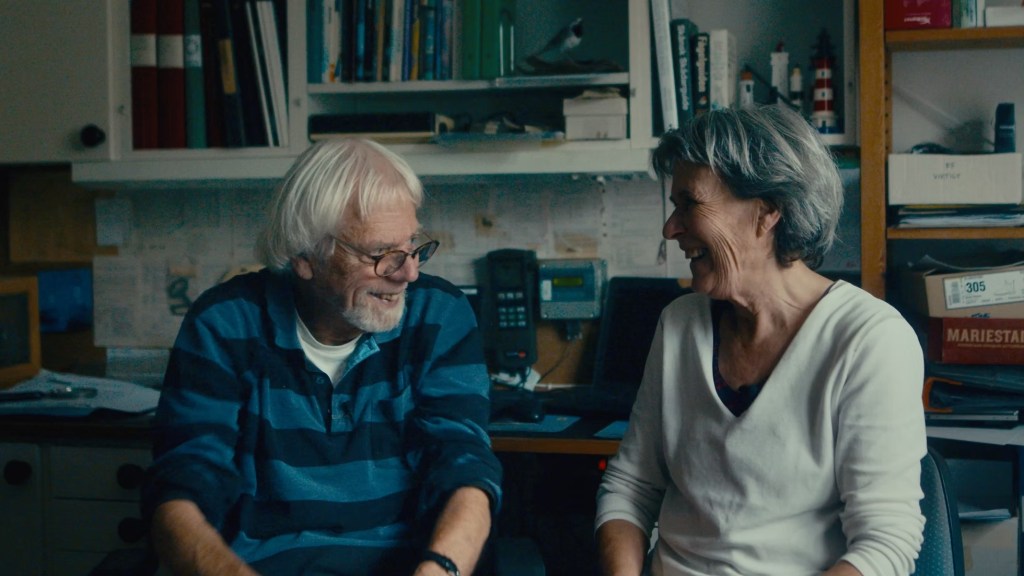
In The Last Observers, Maja K Mikkelsen films her parents Karin and Lennart, who worked for decades at a weather station in Falsterbro, Sweden. This uncommon job required going out every three hours to look at the clouds and record the weather, every day of the year.
During 25 minutes, we follow the couple in their daily activities and learn about their work and personal life through archives and interviews.
The full film is available here:
Every sentence in this film is a slice of wisdom, delivered with generosity, humour and humility. After watching it for the tenth time (looking for the comfort that it never fails to provide), I pondered over some of its life lessons. Forget Yogi Tea tags, here are a few insightful quotes and thoughts that actually make sense.
“Kisses! That’s what makes life worth living.”
The first thing that the spectator notices is the bond between Karin and Lennart, and between the couple and their daughter behind the camera. “We wouldn’t have let anyone else do it”, says the mother about this documentary project. There is trust, care, and tenderness in every scene, conveyed beautifully by the lovely score. These feelings seem to guide the couple’s existence, and their “really lousy” pay appears unimportant in comparison – although they mention it several times… Let it resonate with all the struggling workers out there.
Passion and dedication keep you going
The weather station is also a bird observatory, and the couple talk about their bird-ringing activity with passion. Their total involvement has unexpected consequences – Karin once gave birth in the car because she was determined to put up the nets before heading to the hospital. They carried out their work at the weather station with the same dedication, never missing a single observation. The image of Lennart – a 75-year-old man in mini shorts, wellies, and a red umbrella – diligently recording the weather in the rain brings me a lot of joy.
Things take time
Bird-ringing seems to be a big endeavour – you’re in it for the long haul. As Lennart explains in the film, “when you’ve done it for 25, 30, 40 years, you get a good gauge”. The humility of this sentence strikes me. In a fast-paced world that promotes instant gratification, it’s worth being reminded that regularity and perseverance are sometimes what make a project meaningful. Which brings us to our next point…
There is joy in the routine
Spring, summer, autumn, winter: the film captures the same actions repeated every day throughout the year. For people (like me) who are consistently trying to avoid routines, this lifestyle could seem terribly monotonous. Yet there is something comforting in seeing life unfold in this quiet, predictable way.
“Live where you are and enjoy what’s there”, says Karin. “If you’re happy where you are, you’ll stay. There’s so much to experience and learn”. One could object that it’s easier to be happy “where you are” when it’s a charming lighthouse in a beautiful part of Sweden. Still, Karin has a point: sometimes it’s worth making the most of what you have, rather than checking if the grass is greener elsewhere.
Nature has healing powers
The happy and charismatic couple put their good spirits and good health down to one key factor: “we spend a lot of time outdoors”. Come rain or shine, they’re out staring at the clouds, looking after the birds or welcoming school groups. Fresh air and vitamin D might be the reason they rarely get sick, but nature’s healing power also lies in the sense of perspective you get from living outside. “All living things depend on each other”, and our protagonists experience it daily: plants, insects, animals and humans are all interconnected. Remembering you’re a very small part of “one whole symbiosis” is a good way to put your problems into perspective. It’s also an endless source of wonderment…
Keep your eyes wide open
Beauty is all around – in a frozen cobweb or in the strong temperament of a blue tit. “I can go to the beach at 4.30 and see the sunrise. How am I lucky enough to experience this?” says Karin with delight. Learning to see and appreciate beauty around you is a precious tool against despair or cynicism. Yet, observing the world also means witnessing its worrying changes. “Everything on earth is constantly changing, but at the moment the changes are happening too fast,” the couple explains, adding that “the clouds are much more complicated” than they used to be (something I definitely wasn’t aware of). Beyond the ode to nature, there is a call to action. It’s not about blind optimism but about understanding the world you live in to appreciate it better and do what you can to protect it.
The Last Observers left me feeling a bit nostalgic: the couple has retired, the weather station is now fully automated, the reality we see on screen belongs to the past. But above all, it left me feeling soothed: this place is a haven far from the sound and the fury, and thanks to Maja K Mikkelsen’s film, we are all one click away from Falsterbro Bird Observatory.
More info: https://www.majakmikkelsen.com/film

 UNDERDOG