One of the joys of watching short films is seeing something you probably know nothing about: no poster, no trailer, no rumour preceding it. It’s even truer when this short film is discovered one night on a friend’s computer. This is the experience described by Ian Francis (director of Flatpack and author of This Way to the Revolution) in this text first published in Electric Sheep.
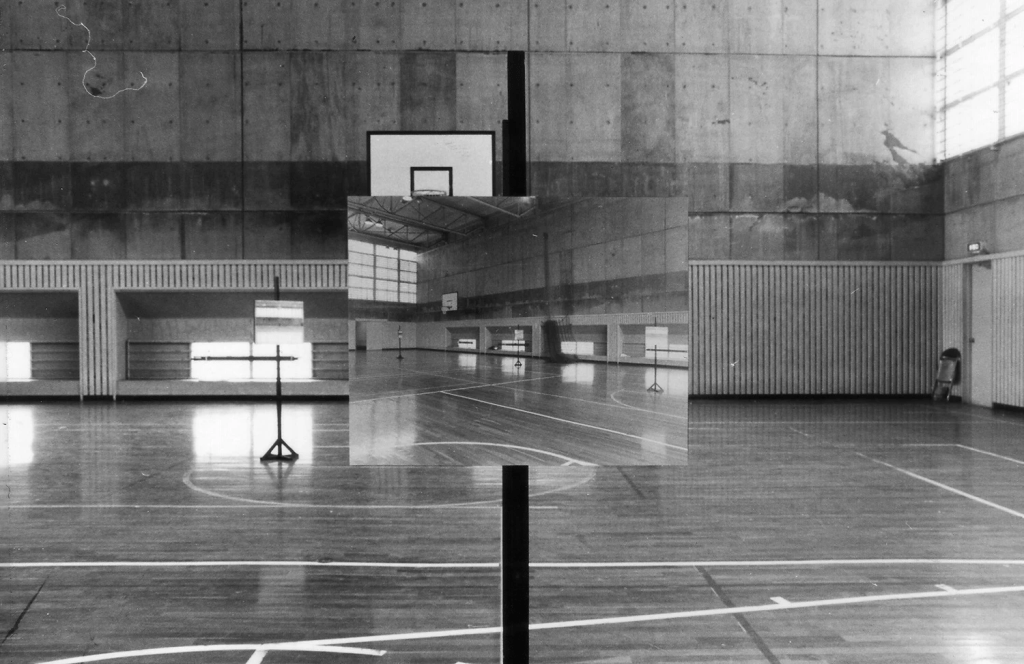
It starts in blackness, punctuated by single-frame glimpses of a ceiling. There are lights, girders, high windows, and as we descend we see basketball hoops. The gaps between frames diminish until we are spinning rapidly around the gym. When we hit floor level we seem to be surrounded by easels. We slide towards one of them and on it is an image of the gym with another easel at the centre of the frame and so on. We continue to zoom towards and into these images, and our trajectory across the gym becomes increasingly complex. The easels begin to move, converging with each other and with us. All the while a queasy clamour of electronic noise has been building up.
It is tempting to try and work out where the join is between film and photograph, even though it has been made clear from the start that we are watching a series of still images. I began to question whether this gym actually existed. Then I started projecting people into the space, a flash of a figure stood in the corner. Before long the analysis dried up and I let the film take me where it wanted to go; continually changing the pace and improvising new variations within the limited rules and geography that it had set for itself, in the way that the best, most manipulative techno music does. The effect is giddy and sinister at the same time. It’s a simile that often gets applied to cinema, but there can’t be many films that take you this close to the sensation of a rollercoaster ride.
Ten minutes well spent. After the euphoria came the urge to contextualise, to hunt down a back-story, to google. The film is called Spacy, and was made in 1981 by Takashi Ito. Is there a print that we could show? (Yes, Light Cone in Paris have it on 16mm.) And how was it created? (From 700 photographs.) And who is Mr Ito? (A professor at Kyoto University. He made the film as a student.) Already Spacy is becoming domesticated. Do we need context? Will a heavily footnoted essay on its contribution to structuralist cinema – or indeed this article – help us to appreciate its power? Probably not. In an ideal world this is a film that would be delivered Lost Highway fashion, an unlabelled cassette in a brown envelope on your doorstep one morning.
– Ian Francis
Cover image: Spacy, Takashi Ito (1981)

 UNDERDOG